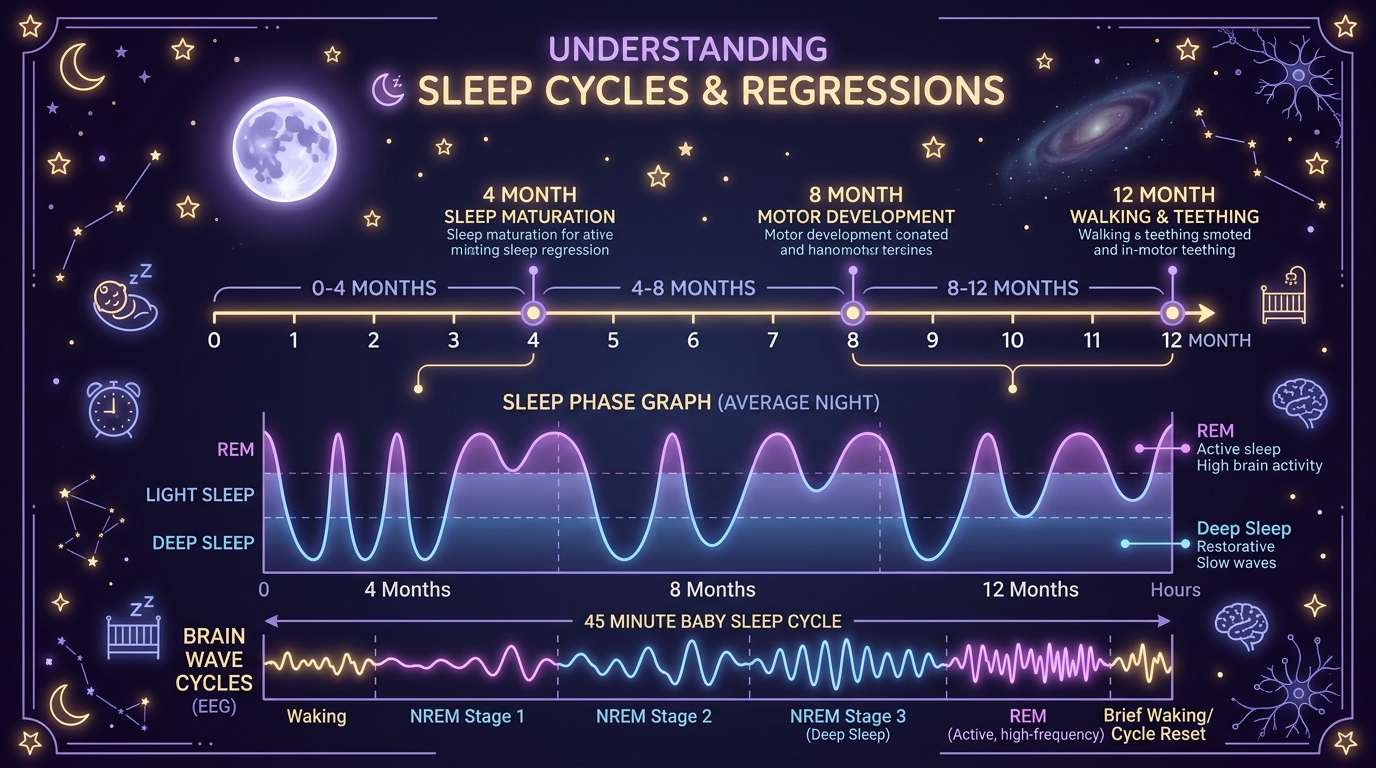
Just when parents celebrate their infant finally sleeping 6-hour stretches, the dreaded 4-month sleep regression arrives: nighttime awakenings every 45 minutes, restless nap resistance, and inconsolable bedtime fussiness. Similar disruptions often resurface around 8 months and 12 months.
Pediatric sleep science confirms that sleep regressions are actually major neurological developmental milestones. According to clinical guidance from the American Academy of Pediatrics (AAP) and the National Sleep Foundation, infant brainwave patterns permanently mature from 2-stage newborn sleep to adult-like 4-stage circadian cycles around 16 weeks of age.
Age-by-Age Wake Window and Nap Targets
Keeping an infant awake beyond their physiological threshold elevates stress cortisol and adrenaline, causing severe sleep onset resistance. Here is how optimal wake windows evolve:
| Age Range | Optimal Wake Window | Daily Nap Count | Common Regression Trigger |
|---|---|---|---|
| 0 to 3 Months | 45 to 90 Minutes | 4 to 5 Naps | Immature circadian rhythm / day-night confusion |
| 4 to 6 Months | 1.5 to 2.5 Hours | 3 Naps | Transition to 4-stage sleep cycles & rolling over |
| 7 to 10 Months | 2.5 to 3.5 Hours | 2 Naps | Separation anxiety peak & crawling development |
| 11 to 15 Months | 3.5 to 4.5 Hours | 1 to 2 Naps | Standing/walking milestones & language explosion |
The Science of Nursery White Noise & Decibels
Continuous pink or white noise mimics the 85-decibel rhythmic whooshing sounds inside the womb, masking household clatter and door clicks. However, the AAP advises keeping sound machines at least 7 feet away from the crib and capped at a safe volume under 50 decibels (equivalent to a quiet shower or gentle rainfall).
The 'Wait 3 Minutes' Self-Soothing Rule
When transitioning between sleep cycles every 50 minutes, infants frequently whimper or shift posture without truly waking. Rushing into the nursery immediately interrupts their self-soothing learning curve.
Smart Monitor Glance Strategy
Using a video baby monitor allows parents to glance at the live screen from the living room to verify the infant is safe and eyes are closed, avoiding unnecessary bedroom visits.
Turn Old Phones into a Modern Baby Monitor
With Bambino: Free Baby Monitor App, you can turn any spare smartphone or iPad into a private, encrypted HD video and audio monitor with smart noise-level sensitivity and night vision over your secure local Wi-Fi.
Baby Wake Windows & Daily Nap Schedule Planner
Generate a precision circadian sleep routine tailored to your baby's exact age stage, wake windows, and morning wake-up time.