
For expecting and new parents, few nursery purchases generate as much debate as choosing between a traditional audio monitor and a high-definition video monitoring system. While audio monitors provide simple auditory cues, video systems allow parents to physically observe breathing patterns, sleep positions, and distress levels without opening the nursery door.
Executive Summary & Research Finding
Choosing between an audio and video baby monitor? Review safe sleep guidelines from the American Academy of Pediatrics, night routine advice, and smart cry detection.
According to safe infant sleep recommendations from the American Academy of Pediatrics (AAP) and the National Institute of Child Health and Human Development (NICHD), continuous parental situational awareness combined with non-intrusive night routines significantly supports safe sleep environments.
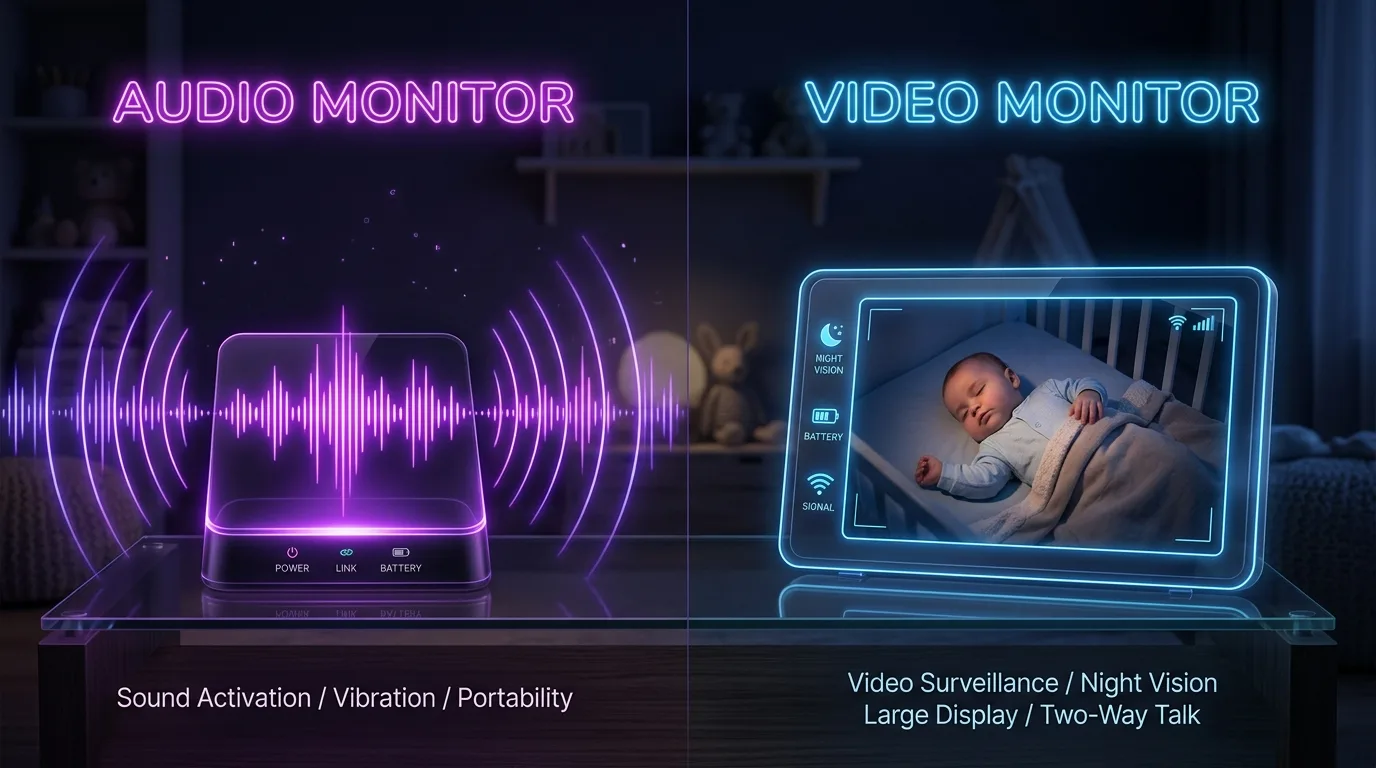
Audio vs Video Monitors: Feature Comparison
| Feature | Audio-Only Monitor | Smart Video Monitor | Pediatric Impact |
|---|---|---|---|
| Sleep Arousal Assessment | Sound only (cannot see if baby is self-soothing) | Real-time visual check without opening door | Prevents premature parental intervention during light sleep |
| Safe Sleep Position Check | Impossible (requires physical room entry) | Immediate visual check for back-sleeping posture | Ensures compliance with AAP safe sleep guidelines |
| Cry Discrimination | All noises sound identical over radio static | Visual confirmation of pacifier loss vs hunger distress | Reduces parental anxiety and nocturnal fatigue |
| Night Vision Clarity | None | Infrared optical sensor without bright nursery lights | Maintains dark melatonin-friendly nursery environment |
Why Pediatric Sleep Coaches Recommend Hybrid Monitoring
Infants naturally transition between active sleep and quiet sleep every 50 to 60 minutes. During active sleep cycles, babies frequently make grunting noises, whimper, and move their arms without actually being awake. Parents with audio-only monitors often rush into the room at the first squeak, inadvertently waking a sleeping child.
A smart video monitor allows you to glance at your screen, verify that your baby's eyes are closed and they are comfortably self-soothing, and let them drift naturally back into deep sleep.
AAP Safe Sleep Guideline Reminder
Always place infants on their backs to sleep on a firm, flat mattress with a fitted sheet. Keep the crib completely free of blankets, pillows, bumpers, and stuffed animals.
Modern Nursery Monitoring on Any Screen
Rather than spending $200 on proprietary hardware monitors, Baboo: Baby Monitor App transforms your phones, tablets, or computers into an encrypted, ultra-low-latency video and audio monitor with smart cry alerts and night vision over your secure home Wi-Fi.
Monitor seamlessly from your work computer or Chromebook using the Baboo Web Baby Monitor App without installing software, or find tips and tools on the official Baboo website.
Baby Wake Windows & Daily Nap Schedule Planner
Generate a precision circadian sleep routine tailored to your baby's exact age stage, wake windows, and morning wake-up time.