
Insomnia is a modern epidemic. We spend our evenings staring at blue-light emitting screens, doom-scrolling through stressful news, and wondering why our brains refuse to shut down when our heads hit the pillow.
Executive Summary & Research Finding
Tossing and turning? Learn how to fall asleep fast by combining the 4-7-8 breathing technique with ambient soundscapes and sleep music.
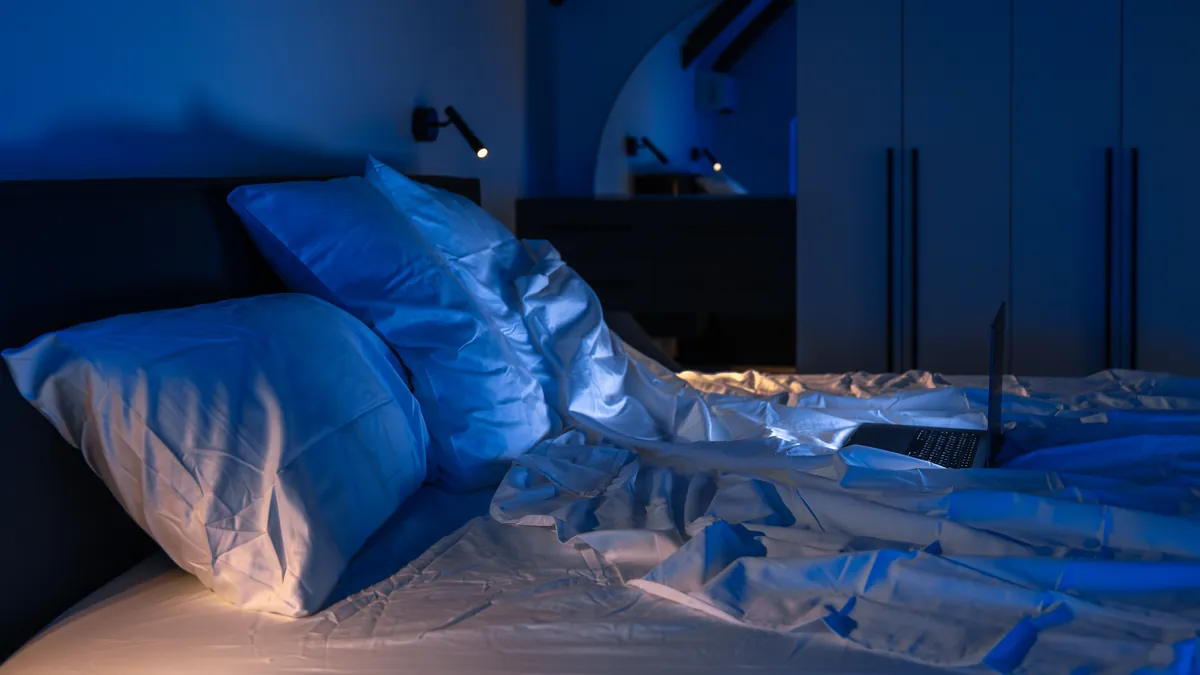
Sleep is not a switch you can just flip off; it is a biological descent that requires a transition period. If you want to fall asleep faster, you must actively disengage your sympathetic nervous system (fight or flight) and engage your parasympathetic nervous system (rest and digest).
The fastest way to achieve this is by combining two therapies: acoustic soundscapes and controlled breathing.
Step 1: Set the Acoustic Environment
Sudden noises—a dog barking, a car driving by, or a house settling—will instantly pull you out of the light stages of sleep. To prevent this, you must mask the environment.
Open the Lumio app and navigate to the Sleep Sounds library. While white noise works, organic ambient soundscapes are often more relaxing because they mimic evolutionary safe spaces. Try setting a timer for the 'Heavy Rain on a Tent' or 'Crackling Fireplace' tracks. These continuous, low-frequency sounds provide a safe acoustic blanket that calms the primitive parts of the brain.
Step 2: The 4-7-8 Breathing Technique
With your soundscape playing, close your eyes and begin the 4-7-8 breathing method, developed by Dr. Andrew Weil. This specific rhythm acts as a natural tranquilizer for the nervous system.
- Inhale: Breathe in quietly through your nose for 4 seconds.
- Hold: Hold your breath for 7 seconds.
- Exhale: Exhale completely through your mouth, making a whoosh sound, for 8 seconds.
- Repeat: Repeat this cycle four times.
The extended exhale forces your heart rate to slow down. When paired with the deep, rhythmic drone of a Lumio sleep soundscape, your brain receives an overwhelming biological signal that it is safe to shut down.